





Toothaches, Facial Nerve Pain & Jaw Pain
Toothaches, Facial Nerve Pain & Jaw Pain: TMJ vs. Trigeminal Neuralgia
Jaw pain can come from tight muscles, irritated joints, sensitive teeth, or facial nerves. Understanding the pattern of your pain can make it much easier to know where to begin and which kind of support makes the most sense.
Jaw pain can be surprisingly difficult to pin down. A sore tooth may feel like it reaches into the jaw. Tight jaw muscles can create headaches and facial tenderness. And nerve pain can sometimes feel so much like tooth pain that it seems to be coming directly from the mouth.
Two conditions that often come up in conversations about severe jaw and facial pain are temporomandibular disorders (TMD) and trigeminal neuralgia. They can affect some of the same areas, but the way they usually feel is quite different.
A small terminology note: TMJ is the temporomandibular joint itself. TMD is the name used for disorders involving that joint and the muscles around it. People commonly say “TMJ pain,” so you’ll still hear both terms.
Why Can Jaw Pain Be So Confusing?
The jaw, teeth, gums, chewing muscles, and facial nerves all sit close together. Pain from one area can easily be felt somewhere else.
Often feels sore, tired, tight, or achy and may become worse with chewing or clenching.
More often feels sharp, shooting, burning, stabbing, or like a sudden electric shock.
May center around one tooth and react to pressure, cold, heat, sweets, or dental work.
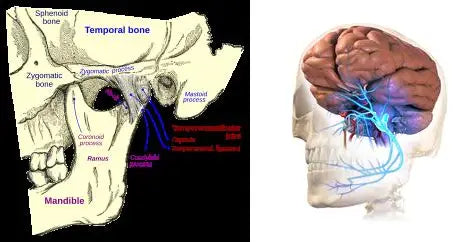
What Does TMJ or TMD Pain Feel Like?
The temporomandibular joints sit just in front of the ears and connect the lower jaw to the skull. They work together with the muscles that let you chew, speak, yawn, and move your jaw from side to side.
When the joint or surrounding muscles become irritated or tense, you may notice:
- Aching or tenderness around the jaw, cheek, or temple.
- Pain while chewing or after eating tougher foods.
- Jaw tightness or stiffness, especially after waking.
- Clenching or grinding, particularly during stressful periods or sleep.
- Painful clicking or popping when opening or closing the mouth.
- Difficulty opening the jaw fully or occasional locking.
- Headaches, ear-area discomfort, or neck tension along with jaw soreness.
Interestingly, a jaw that clicks without pain is quite common and does not automatically mean something is wrong. What matters more is whether the clicking comes with pain, stiffness, locking, or difficulty moving the jaw.
Notice when it happens. Jaw pain that is strongest in the morning may be a clue that you are clenching or grinding during sleep. Pain that builds through the day may be connected with stress, chewing, posture, or repeated jaw tension.
What Does Trigeminal Neuralgia Feel Like?
Trigeminal neuralgia is different. It involves the trigeminal nerve, the major nerve that carries sensation from the face to the brain.
Because branches of this nerve supply the jaw, teeth, gums, lips, cheek, forehead, and area around the eye, trigeminal nerve pain can sometimes feel as though it is coming from a tooth or the jaw itself.
The classic pain pattern is much more sudden than ordinary jaw tension:
- Sharp, stabbing, or electric-shock-like pain.
- Sudden attacks that may last seconds to several minutes.
- Pain mainly on one side of the face.
- Very light triggers such as brushing the teeth, chewing, talking, washing the face, or touching the skin.
- Pain along the cheek, jaw, teeth, gums, or lips.
Why people sometimes mistake it for a tooth problem: the same trigeminal nerve that carries sensation from the face also carries sensation from the teeth and gums. A nerve attack can therefore feel surprisingly dental even when the tooth itself is not the source.
TMJ, Trigeminal Neuralgia, or Tooth Sensitivity?
The character of the pain can give you useful clues.
| Pattern | How it often feels | Common clues |
|---|---|---|
| TMD / jaw tension | Aching, pressure, tightness, soreness | Worse with chewing, clenching, grinding, or opening the mouth |
| Trigeminal nerve pain | Sharp, shooting, stabbing, electric | Sudden attacks triggered by touch, speaking, chewing, or brushing teeth |
| Tooth sensitivity | Quick tooth-centered twinge or ache | Triggered by cold, heat, sweets, pressure, exposed dentin, or recent dental work |
| Dental infection | Persistent, throbbing, or worsening pain | May come with swelling, tenderness, bad taste, fever, or pain when biting |
How Traditional Homeopathy Looks at Facial and Jaw Pain
Traditional homeopathy pays close attention to how the pain feels.
Is it stabbing or aching? Does it come in sudden shocks? Is there cramping or muscle spasm? Does warmth help? Is the area tender or swollen? These details help distinguish one remedy picture from another.
In simple terms: sharp nerve pain, tight spasming muscles, and sensitive teeth are not all treated as the same problem. Traditional remedy selection looks for the support that best matches the pattern you are actually experiencing.
Cell Salts for Tooth Sensitivity and Jaw Tension
For people whose discomfort includes a mixture of sensitive teeth, jaw tightness, muscle spasms, or soreness after dental work, three cell salts come up repeatedly in traditional biochemic practice: Ferr Phos, Mag Phos, and Calc Fluor.
Ferr Phos
Ferrum Phosphoricum is traditionally associated with the early stages of tenderness, heat, redness, swelling, and discomfort. In oral care, it is often chosen when tissues feel newly irritated or sensitive.
Mag Phos
Magnesia Phosphorica is commonly known in the cell-salt tradition as the salt for cramps, spasms, and neuralgic pain. It is traditionally chosen when discomfort is sharp, shooting, cramping, or connected with tense muscles.
Calc Fluor
Calcarea Fluorica is traditionally associated with the strength and elasticity of structural tissues. In Schuessler’s system, it has a longstanding connection with tooth enamel, connective tissue, and areas that need firmness and resilience.

When sensitivity and jaw tension come together
BIO23 combines Ferr Phos, Mag Phos, and Calc Fluor 6X in one formula for tooth sensitivity and oral discomfort.
The combination brings together three traditional patterns: early tenderness, nerve and muscle spasm, and structural support for teeth, gums, and surrounding tissues.
It is a practical choice when your discomfort is a mix of sensitivity, jaw tension, spasms, or soreness around the mouth.
Shop BIO23When the Pain Feels More Like an Electric Shock
The traditional homeopathic picture changes when facial pain is sudden, severe, stabbing, shooting, or electric rather than simply sore or tight.
For this pattern, a formula specifically designed around facial nerve pain may make more sense than a general jaw or tooth-sensitivity remedy.

For sharp and stabbing facial nerve sensations
BM123 Trigeminal Neuralgia Support is formulated around the traditional homeopathic picture of sudden facial nerve pain: stabbing, shooting, piercing, burning, or electric-shock-like sensations.
It is the more targeted option when the dominant problem is the nerve-pain pattern rather than muscle tightness or ordinary tooth sensitivity.
Shop BM123What If the Main Problem Is Tooth Sensitivity?
Sometimes jaw discomfort really does begin with the tooth itself. Enamel wear, exposed dentin, gum recession, grinding, acidic foods and drinks, or recent dental work can all make a tooth more reactive.
If your main complaint is sensitivity to hot, cold, or sweets rather than shooting facial pain or tight jaw muscles, it makes sense to focus more directly on the teeth.

For enamel strength and everyday tooth sensitivity
Tooth Remineralization Support combines Calc Phos 12X, Calc Fluor 12X, and Silicea 12X.
These three cell salts are traditionally associated with teeth, enamel, mineral balance, connective tissues, and long-term structural support.
It is a great option when sensitive teeth are the main concern.
Shop Tooth RemineralizationSimple Ways to Give Your Jaw a Break
Whatever approach you use, a few simple habits can reduce the amount of work your jaw has to do while it is irritated.
- Choose softer foods temporarily: soups, eggs, cooked vegetables, oatmeal, yogurt, fish, and other foods that require less chewing.
- Skip chewing gum: repetitive chewing can keep already-tired jaw muscles working all day.
- Notice clenching: during the day, let your teeth rest slightly apart rather than holding them tightly together.
- Use gentle warmth: a warm compress can feel relaxing when muscles are tight or overworked.
- Avoid very wide opening: take care with huge bites and exaggerated yawning when the joint is irritated.
- Pay attention to stress: many people unconsciously tighten the jaw when concentrating, driving, working, or feeling anxious.
Try this quick jaw check: Are your shoulders raised? Is your tongue tense? Are your teeth touching even though you are not eating? Relax your shoulders, let the tongue rest gently, and allow a little space between your upper and lower teeth.
When Should You See a Dentist or Doctor?
Not every toothache or sore jaw is something to manage at home. Get professional advice when pain is severe, keeps returning, or you are not sure where it is coming from.
- Persistent or worsening tooth pain should be checked for decay, infection, cracks, or other dental problems.
- Facial or gum swelling, fever, or a bad taste in the mouth may point to a dental infection.
- Repeated electric-shock facial pain deserves medical evaluation for trigeminal neuralgia or another nerve condition.
- A jaw that repeatedly locks or becomes increasingly difficult to open should be assessed.
- New facial weakness, major numbness, trouble swallowing, or trouble breathing needs prompt medical attention.
One important point: repeated severe facial pain should not automatically be assumed to be a bad tooth. If dental examination does not explain the pain, ask if a nerve-related cause should be considered.
FAQs
Can TMJ pain feel like a toothache?
Yes. Tight chewing muscles and irritation around the jaw joint can create referred pain that feels as though it is coming from the teeth, cheek, ear, or temple.
Can trigeminal neuralgia feel like tooth pain?
Yes. The trigeminal nerve carries sensation from the teeth and gums as well as the face. Trigeminal neuralgia can therefore produce severe pain that seems dental even when the tooth itself is not the source.
Which cell salt is traditionally used for jaw spasms?
Mag Phos is traditionally known as the cell salt for cramps, spasms, and sharp neuralgic discomfort. BIO23 combines Mag Phos with Ferr Phos and Calc Fluor for broader tooth and jaw support.
Which product makes the most sense for me?
If sensitivity and jaw tension occur together, BIO23 is the broadest fit. If the pain is distinctly electric, stabbing, or shooting along the face, BM123 is the more targeted traditional homeopathic option. If the main concern is sensitive teeth and enamel support, Tooth Remineralization is the more focused choice.
Can I still use homeopathic remedies if I am seeing a dentist or doctor?
They can be incorporated into a broader care routine. Follow the product directions and let your healthcare professional know what you are taking, particularly if you are being treated for persistent or severe facial pain.
The Bottom Line
Jaw pain is not all the same. A tired, tight jaw after clenching is very different from a sudden electric shock through the cheek. And both are different again from a tooth that reacts every time you drink something cold.
Start by paying attention to the character, location, triggers, and timing of the discomfort. Those details can help you understand if the pattern points more toward the jaw muscles and joint, the teeth, or the trigeminal nerve.
Choose support that matches the pattern:
- BIO23: for a combination of tooth sensitivity, jaw tightness, nerve discomfort, and spasmodic jaw tension.
- BM123: for the traditional homeopathic pattern of sharp, stabbing, shooting, or electric-shock facial nerve sensations.
- Tooth Remineralization Support: for sensitive teeth, enamel support, and long-term oral wellness.
Homeopathic and cell salt uses described above are based on traditional homeopathic and biochemic practice and are not accepted medical evidence. These statements have not been evaluated by the FDA. This information is for general wellness education and is not a substitute for professional medical or dental diagnosis or treatment.
Will this work with a trigeminal neuralgia headache
I have tmjd I had a tooth pulled recently which caused inflammation in my jaw to flare up. Would this product help? I do not have a homeopathic doctor. I also have a lot of pollen allergies and gastritis
Leave a comment